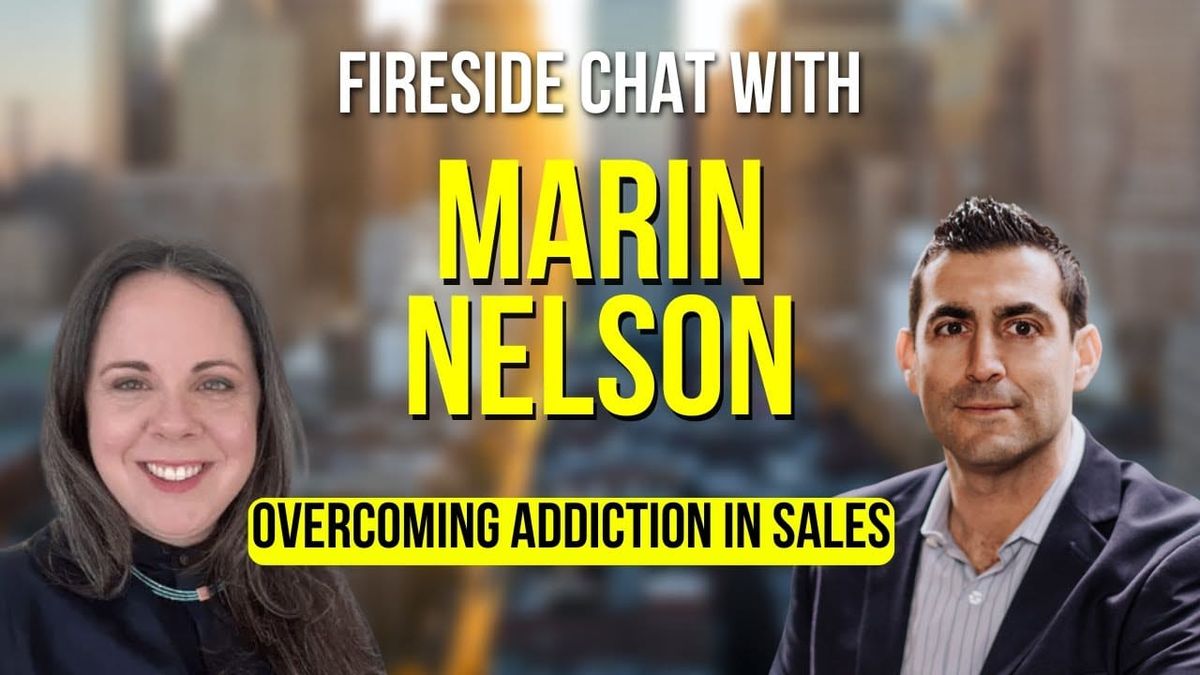
Original source: Ian Koniak Sales Coaching
This video from Ian Koniak Sales Coaching covered a lot of ground. 4 segments stood out as worth your time. Everything below links directly to the timestamp in the original video.
If you have ever watched a colleague struggle at a work event and said nothing, this conversation explains why that silence costs more than most people realize.
46 Million Americans Struggle With Substance Use Disorder as Workplace Silence Enables the Crisis
Forty-six million Americans currently live with substance use disorder — and that figure excludes behavioral addictions entirely. Speaking from personal experience, Marin Nelson, co-founder of Soberforce, described the pattern familiar to anyone who has attended a corporate conference: a colleague visibly overindulges, stumbles back to the hotel, and the next morning everyone pretends not to have noticed. That collective silence, she argued, is not kindness — it is abandonment dressed up as discretion. The goal of bringing addiction conversations into the workplace, she said, is equipping colleagues with language to express concern rather than defaulting to avoidance.
The scale of the problem makes the silence harder to justify. Substance use disorder cuts across every industry — nonprofits, media, healthcare, and sales alike — yet professional settings have historically treated it as a private matter unsuitable for open discussion. Nelson's argument is that community built inside the workplace can reduce the isolation that makes recovery harder, allowing newly sober professionals to navigate events like sales kickoffs without facing them alone.
"Everyone saw that person last night stumbling back to the hotel — and that, to me, is just not a loving way to be in this world."
Sales Coach Ian Koniak Speaks Publicly About Pornography Addiction, Arguing Behavioral Compulsions Are Overlooked in Recovery Conversations
Ian Koniak, who coaches sales professionals, disclosed that his primary addiction was not alcohol or drugs but pornography and compulsive sexual behavior — conditions he says carry disproportionate stigma even as they become more widely discussed. He described a broader pattern of accumulating and shedding compulsions over time: after addressing the dominant addiction, he gradually stopped drinking heavily, then quit marijuana, and eventually stopped taking Adderall. His central observation is that most people with addictive tendencies have one defining habit — the one they most want to quit — and that the rest often follow once that anchor is addressed.
The disclosure is notable in a professional context where behavioral addictions rarely surface. Marin Nelson, reflecting on the same pattern through her work with Soberforce, noted that recovery pathways have multiplied significantly compared to what existed two decades ago, when 12-step programs were essentially the only structured option. That expansion matters because the dominant-addiction framework Koniak describes does not map neatly onto abstinence-only models, suggesting that more flexible, community-based approaches may reach people who would otherwise disengage.
"There's typically one thing that is the dominant thing that tends to haunt people — that they really do want to call it quits with entirely."
Sober Sales Leaders at Salesforce Changed Young Reps' Assumption That Drinking Was Required to Succeed
When Soberforce launched as an employee resource group at Salesforce in 2020, one of the most common concerns raised in its early sessions came from employees in their early twenties who believed that drinking with clients was simply part of the job. What changed their perception, according to Marin Nelson, was not a policy or a prohibition — it was seeing senior sales leaders openly identify as sober while demonstrating professional success. The visible presence of those role models reframed the question from whether someone could decline a drink to whether they could still perform and advance if they did.
The broader tension the conversation surfaces is structural: alcohol is deeply embedded in sales culture through client dinners, golf outings, and kickoff events, and many professionals genuinely worry that opting out signals social disengagement. Nelson's account from Salesforce suggests that cultural norms in even the most drink-heavy professional environments can shift when people in positions of authority model a different standard — without requiring a formal policy change to do it.
"I'm sober and I'm in sales and I'm successful — that tells me that maybe I can be successful too."
Shame, Not the Habit Itself, Is Often the Clearest Signal That an Addiction Needs Addressing
The most practical diagnostic tool for identifying a problematic relationship with any habit, according to Ian Koniak, is not frequency or quantity but the emotional aftermath. Drawing on research he cited broadly rather than by source, Koniak placed shame at the lowest point on the spectrum of human emotional states — below sadness, anger, and bitterness — and argued that the shame cycle, in which a person feels deep self-disgust after an activity yet repeats it regardless, is more destructive to performance and wellbeing than the activity in isolation. He illustrated the point with the case of a salesperson who tripled his revenue after giving up video games, framing it as evidence that removing a source of shame unlocks capacity across every area of life.
The implication runs counter to the common assumption that shame motivates change. Koniak's argument, consistent with a growing body of behavioral research, is the opposite: chronic shame paralyzes rather than propels, making it impossible to show up with confidence or presence. For professionals reluctant to label their habits as addictions, the question he poses — do you feel shame after? — offers a lower-stakes entry point into what he and Nelson call sober curiosity.
"If you're feeling ashamed, if you're beating yourself up and you don't want to do it but you keep repeating it — that shame cycle can have a detrimental effect."
Also mentioned in this video
- Ian Koniak presenta a Marin Nelson para hablar sobre la desestigmatización de… (0:00)
- Ian Koniak presenta el trasfondo de Marin Nelson, CEO y cofundadora de… (1:01)
- Marin Nelson agradece la introducción y comenta sobre la importancia de la… (2:51)
- Marin Nelson comparte su historia personal de recuperación del alcoholismo y… (3:35)
- Marin Nelson explica que, si bien su camino hacia la sobriedad se centró en… (7:03)
Summarised from Ian Koniak Sales Coaching · 1:02:52. All credit belongs to the original creators. Streamed.News summarises publicly available video content.