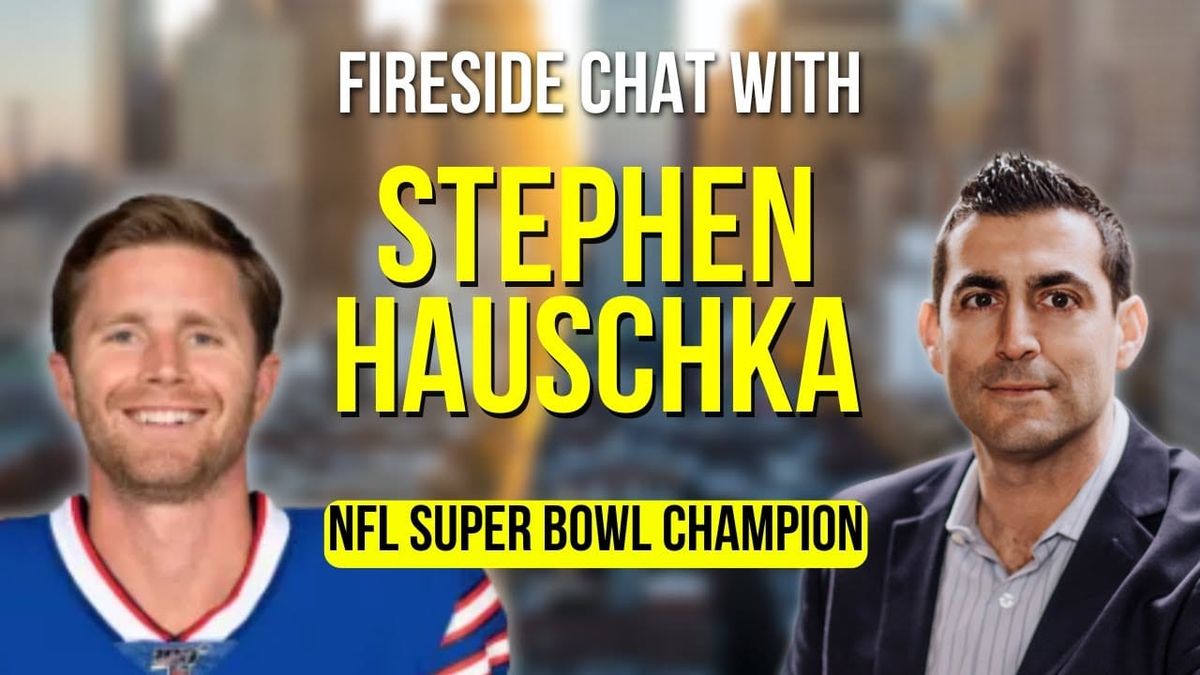
Original source: Ian Koniak Sales Coaching
This video from Ian Koniak Sales Coaching covered a lot of ground. 5 segments stood out as worth your time. Everything below links directly to the timestamp in the original video.
If relentless practice isn't closing the gap between your ability and your performance, the bottleneck may be neurological — and there's a measurable technique for it.
Former NFL Kicker Credits Emotional Freedom Technique With 40% Cortisol Drop
Stephen Hauschka, who spent 15 years as a professional kicker, turned to a practice called Emotional Freedom Technique — commonly known as tapping, which involves stimulating acupuncture points on the body while voicing specific fears — after discovering that extra practice alone could not quiet the anxiety of performing in front of tens of thousands of people. Drawing on a neuroscience background, he explained that the amygdala, an almond-shaped cluster of neurons that functions as the brain's threat-detection system, triggers a flood of hormones and physical stress responses before the rational mind can intervene. Research he cited suggests a single tapping session can reduce cortisol levels by 40%, effectively short-circuiting that threat response.
The broader implication reaches well beyond sport. The same fight-or-flight hijacking that derails a field goal attempt in the NFL also undermines high-stakes presentations, difficult conversations, and any task requiring fine motor or cognitive precision under pressure. Hauschka's case offers a concrete, research-backed illustration of why emotional regulation — not just skill repetition — is the missing variable in elite performance.
"One session of tapping can lower cortisol by 40%. It can rewire your thoughts, your actions, your behaviors — it was a way to change states quickly and cultivate the mindset I wanted before I even got to the game."
NFL Veteran Develops Four-Step 'RISE' Method to Convert Fear Into Action in Minutes
After years of relying on a 15-minute tapping routine, Stephen Hauschka developed a faster framework he calls RISE — Recognize the fear, Invite compassion, Strengthen mindset, Embrace the opportunity — designed to move someone from paralysis to productive action in real time. He tested it on himself after losing hours of work on a speech when his computer froze, identifying the underlying fear as a worry that his message would never reach the world. By working through all four steps, he converted acute stress into enthusiasm and completed the project within days, estimating the emotional pivot took roughly three minutes.
What makes the framework notable is its claimed universality: Hauschka argues the same fear mechanism drives procrastination, addictive behavior, and performance anxiety, meaning RISE is not a sports-specific tool. The approach mirrors ideas from executive coaching — his reference to coach Chris Doris's 'O-line' method for PGA golfers suggests a broader cross-disciplinary convergence around the idea that reframing a problem as an opportunity is both learnable and fast.
"Behind every kind of compensated behavior I think there's usually a fear attached to it."
Hauschka's NFL Turnaround Came When He Stopped Trying to Look Right on Tape
Early in his NFL career, Stephen Hauschka made the common mistake of overhauling his kicking technique to conform to what he thought coaches wanted to see on film, a change that made performance worse rather than better. It was only after a run of injuries pushed him to the edge of the league that he abandoned the imposed style, decided the result mattered more than the method, and committed entirely to his own approach. Combined with his tapping practice, that decision produced what he described as deep self-trust — the quality he credits for nailing consecutive field goals of 55 and 56 yards in a game at Atlanta while playing for the Buffalo Bills, with 70,000 opposing fans screaming.
The story illustrates a tension that extends far beyond athletics: institutional pressure to conform to a prescribed method can actively suppress the individual variation that produces elite results. Hauschka's experience suggests that the most dangerous period for a talented performer is often not the beginning, when failure is expected, but the middle — when external feedback is loudest and self-doubt is most easily weaponized.
"I don't care what it looks like. I'm just going to go get the ball through the uprights and do it my way — and that was one of the most powerful things."
Hauschka's Pre-Game Mental Routine Treated Fear as Fuel, Not Obstacle
Rather than suppressing anxiety before games, Stephen Hauschka built a structured 15-minute routine that first acknowledged specific fears — concerns about the wind, or the memory of a previous miss — and then used those same emotions as raw material to construct what he called the ideal competitive mindset. The process moved in two phases: a release stage that named and let go of worries, followed by an affirmation stage paired with continued tapping at acupuncture points, in which he built toward a target state he described as somewhere between a warrior's intensity and a golfer's relaxed precision. He performed the full sequence the night before a game, again the morning of, and then used that elevated state as the platform for visualization.
The method reflects a growing consensus in sports psychology that emotional suppression is less effective than emotional transformation. By treating fear as energy to be redirected rather than noise to be eliminated, Hauschka's approach offers a practical model for anyone who needs to shift mental states before a high-stakes event — the mechanism is portable even if the specific affirmations must be individually calibrated.
"When you're not aware of your fears they kind of hold power over you. But by just acknowledging and releasing them a little bit, you can step into your ideal competitive mindset."
Self-Compassion, Not Mental Toughness, Became Hauschka's Tool for Bouncing Back From High-Stakes Failures
A missed 29-yard field goal for the Seattle Seahawks against Arizona — a distance considered routine at the professional level — sent Hauschka into a prolonged period of shame and sleeplessness, replaying the kick involuntarily through the night. Years later, a similar miss for the Buffalo Bills produced a strikingly different response: jogging off the field, he felt genuine compassion for himself for the first time, an acknowledgment that the profession is inherently brutal and that mistakes, however costly, are survivable. He defined resilience not as the absence of pain but as the speed of return to one's ideal state, and named self-compassion as the mechanism that determines that speed.
The contrast between his early and late career responses has implications beyond sport. The punishing inner voice that kept him awake after early failures is the same one that makes people avoid risk, delay recovery, and underperform in demanding roles. Hauschka's arc — from rumination that lasted all night to the capacity to forgive himself on the field before reaching the sideline — points to self-compassion as a trainable performance variable, not merely a therapeutic concept.
"Early in my career I could play the kick over in my head whether I wanted to or not, all night long — I wouldn't sleep. At the end of my career, I could sleep. There was a love for myself: that sucks, and I know I'll bounce back."
▶ Watch this segment — 1:01:25
Summarised from Ian Koniak Sales Coaching · 1:17:23. All credit belongs to the original creators. Streamed.News summarises publicly available video content.