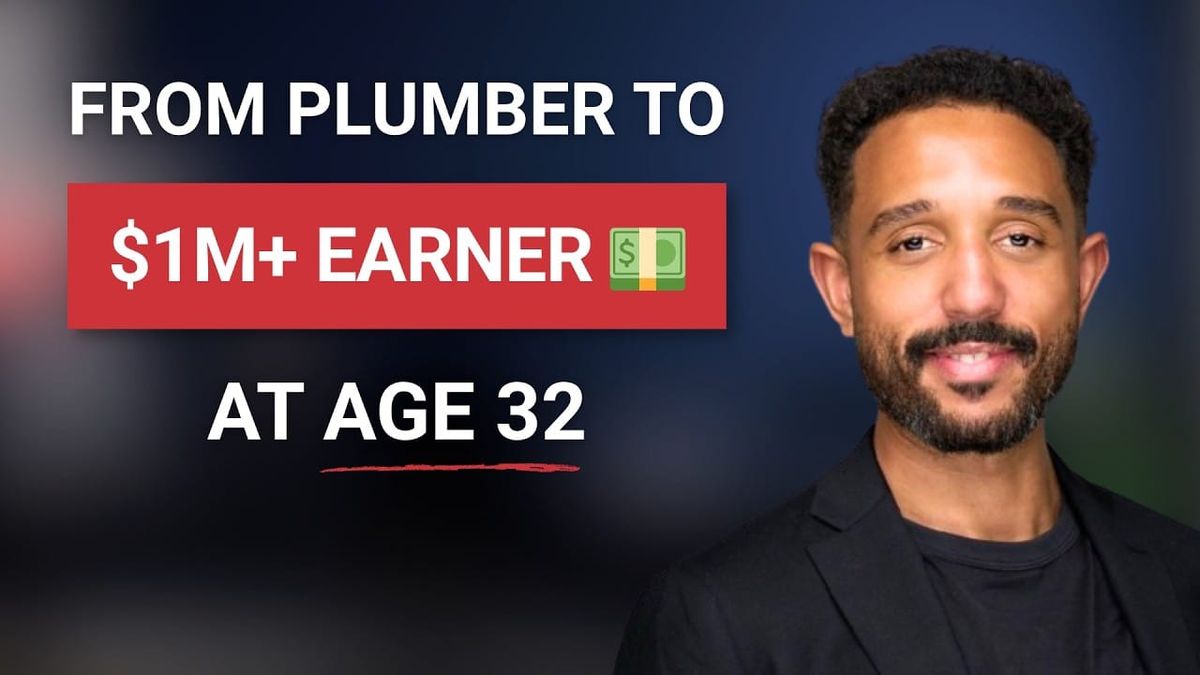
Original source: Ian Koniak Sales Coaching
This video from Ian Koniak Sales Coaching covered a lot of ground. 11 segments stood out as worth your time. Everything below links directly to the timestamp in the original video.
High performers are often celebrated for their drive, but Jones's account raises a harder question: what happens when the engine running that drive is a wound that achievement can never actually heal?
Sales Executive's Coaching Breakthrough: 'The Only Time I Believed I Was Capable of Being Loved Is When I'm Achieving'
At 32, Robbie Jones reached a realization through coaching that reframed his entire professional drive: he had spent his life believing he was only worthy of love when he was achieving something. That conviction, he says, functioned as rocket fuel — making relentless work feel effortless and every competitive situation feel like a matter of survival. He wept when the insight surfaced, describing it as something that had taken three decades to fully surface.
The disclosure is notable because it reframes high performance not as ambition but as a psychological coping mechanism rooted in conditional self-worth. For the millions of professionals who conflate achievement with identity, Jones's articulation offers a rare, concrete example of how childhood emotional environments can quietly drive — and eventually hollow out — extraordinary careers.
"The only time I believed that I was capable of being loved is when I'm achieving. And that wiring is jet fuel."
Growing Up With Addicted Parents Forged the Drive — and the Destructive Habits — of a Top Tech Sales Earner
Robbie Jones grew up in a ground-floor two-bedroom apartment in Canada, unable to afford basketball shoes or family vacations, while both parents struggled with addiction through most of his adolescence and into his early twenties. That environment of scarcity — of food, money, attention — planted a vow that his life would be different. But before that energy found a constructive outlet, it moved through rage, resentment, and his own addictions. When he finally landed in door-to-door sales, the rush of closing deals became its own compulsion: he spent every weekly paycheck the moment it arrived, buying clothes and shoes to fill a void that money couldn't permanently close.
The pattern Jones describes — scarcity in childhood producing a compulsive, spendthrift relationship with money in early adulthood — mirrors dynamics well-documented in behavioral economics and trauma research. His candor on a sales-focused podcast is unusual, and the arc from that ground-floor apartment to earning over $500,000 a year at SAP reframes elite sales performance as something with psychological roots that most career-advice conversations never reach.
"Every deal was like a hit. It was instant. And every Friday, I would go out and spend it all — then back at it on Monday."
The Shift That Took a SAP Rep From Mid-Market Mediocrity to Seven-Figure Earnings: Stop Counting Your Commission
Robbie Jones credits a single philosophical shift for transforming his sales career: moving from asking 'what can I get?' to asking 'what can I give?' In his mid-market years, he was focused on his own earnings; when he took on a strategic account role managing one customer over three years, he redirected all attention to that client's goals. He routinely gave advice that reduced his own compensation — telling clients a different approach would serve them better, or that his product wasn't the right fit at all. The relationships he built became friendships that lasted beyond the deal, with former clients still greeting him at conferences years later.
The approach — often described as consultative or customer-centric selling — is widely preached in enterprise sales but rarely practiced as consistently as Jones describes. His example matters because it comes with a documented outcome: four consecutive years of earnings above $500,000, totaling well over $7 million, suggesting that deprioritizing short-term commission in favor of genuine client advocacy produces compounding returns that transactional selling cannot match.
"There were numerous times when I advised them to do something that negatively impacted my compensation. I actually recommend you do it this way — even though it impacted my earnings."
Sales Rep Traces His Achievement Obsession to Childhood: Performing Made His Addicted Parents Pay Attention
Robbie Jones has a working hypothesis about why he came to believe that achievement was the only path to love: in a home shaped by addiction, he was not naturally a priority. But when he could lend his parents money, excel at basketball, or earn recognition — such as being nominated top sales student of the year at the British Columbia Institute of Technology — parental attention would shift toward him. Achievement, he theorizes, created a feedback loop in which being noticed required constantly producing a result. He returned to therapy with this newly articulate insight, describing it as something he couldn't have named in earlier sessions.
The hypothesis carries one additional layer he hadn't previously considered: if his parents were paying attention to what he was achieving, they weren't using. Achievement may have been not just a bid for love but an unconscious attempt to keep his parents present and sober — placing the emotional labor of family stability on a child's performance record.
"When you could do these things, your parents' focus shifts. You become a priority. You're like, 'I'm noticed.' So then that creates this loop where it's like, I've got to do that again."
A Trip to Italy Offered a Glimpse of What Sobriety Could Look Like — and Why Achievement Felt Like a Lifeline
Ian Koniak, reflecting on Robbie Jones's childhood, floated a deeper reading of his drive: that achieving wasn't only about earning love, but about keeping his parents sober. The logic is that parents who are actively engaged in celebrating a child's success are, by definition, not using. Jones hadn't considered that framing before, but confirmed it landed. Two years before the conversation, he and his partner took both their mothers to Italy for two weeks — and he described his mother as more present, more happy, and more sober than he had ever seen her. The memory visibly moved him.
The moment grounds an otherwise abstract psychological discussion in something concrete. It also reframes the extraordinary financial ambition Jones pursued throughout his sales career: the underlying goal may never have been the money or the recognition at all, but a version of family that addiction had put perpetually out of reach.
"That was the most happy, the most present, the most sober I've ever seen my mom."
No Tech Background, No College Degree: How a Door-to-Door Salesman Got Into SAP
After years in construction, trades, and door-to-door sales, Robbie Jones hit an educational ceiling and went looking for a sales school. His grandfather suggested the idea, and Jones found what he describes as the only such institution in British Columbia: the British Columbia Institute of Technology, which offered a two-year Marketing Management Professional Sales program with a guaranteed job placement at the end. The program ran eight to nine courses per semester, with school days stretching from 8 a.m. to 5 p.m. Jones, who had never been academically inclined, had to build an entirely new self-concept around being a capable student. He was nominated — though not selected — as top sales student of the year.
The path matters because it sidesteps the conventional assumption that breaking into enterprise tech sales requires either a computer science degree or a pre-existing professional network. Jones's route — trades, door-to-door, specialized vocational certificate — is an available template that the industry rarely promotes but that, in his case, led directly to a seven-figure career at one of the world's largest enterprise software companies.
"I found the only sales school in British Columbia. At the end of it, they guaranteed a job. I was like, 'That sounds perfect.'"
SAP's Top Earner in One Sales Program Cleared $7 Million Over Four Years — and the Math Makes the Case for Elite Performance
Robbie Jones was recognized as the highest earner in a sales coaching program that tracks members earning above $500,000 annually, having exceeded $7 million in total earnings with four consecutive years above that threshold, including a peak year in 2019. His host, Ian Koniak, framed the numbers in stark comparative terms: a competent mid-market sales rep earning $150,000 to $200,000 per year would need roughly 20 years to accumulate the $3 million that an elite tech sales performer earning $750,000 annually could reach in just four. That is a five-to-one ratio in time-to-wealth, with both roles available within the same industry.
The arithmetic is deliberately blunt, aimed at sales professionals who accept lower earnings without fully calculating the long-term cost of that gap. In an era when compensation transparency is increasing across industries, the case Koniak makes — that the distance between a good and a great outcome in enterprise tech sales is measured not in percentages but in decades — has implications for how professionals think about career investment, skill development, and the value of sales as a high-ceiling profession.
"You can make $3 million in 4 years at $750,000, where it would take 20 years to make that same amount at $150,000."
'It's Not About You': How Outward Focus Became the Defining Principle of Elite Enterprise Sales
Asked to define the term 'outward focus,' Robbie Jones offered a precise answer: the salesperson is simply a tool for helping the client reach their objectives — professional, personal, or financial. That means aligning with a buyer's ambitions, whether they want to move from director to senior vice president or hit a target EBITDA figure, and then honestly assessing whether you can actually help them get there. On multiple occasions, Jones told clients he couldn't help them at all. The practice sounds commercially self-defeating but, in practice, built the kind of trust that kept clients coming back and opening up with more of their strategic challenges.
Koniak noted the psychological irony explicitly: for someone who spent decades believing he had to achieve in order to be loved, succeeding in enterprise sales required him to set that identity entirely aside. The money he had always chased arrived precisely when he stopped chasing it — and started showing up as a genuine partner to his clients rather than a quota carrier.
"It's not about you. It's not about the products. It's not about pitching. It's literally about a partnership, a collaboration where you are focused on their success, not your own."
From SAP's Internal Academy to $400,000 in Year One: The Career Ladder That Mid-Market Reps Miss
After completing SAP's internal early-talent program — a nine-month academy he joined after two difficult years hitting only 20 to 28 percent of quota in the mid-market team — Robbie Jones was hired as a line-of-business account executive and earned between $400,000 and $500,000 in his first year, qualifying for the company's top-performers club. His manager then pushed him to relocate from Canada to the western United States to take on a core account executive role in the strategic customer program. Jones resisted initially but relented, and spent three years managing a single account — a structure that ultimately produced the multi-year run of high earnings that defined his career.
The trajectory illustrates a specific ladder inside large enterprise software companies that is poorly understood from the outside: the early-talent academy serves as a reset mechanism for internal candidates struggling in mismatched roles, and the strategic account program — where one rep owns one major client for years — is where the largest commissions are generated. Jones's path from near-failure to seven-figure earnings without ever leaving the same company offers a practical roadmap for reps who assume the only way up is out.
"I go to club my first year, making like $400,000, $500,000 grand. And good thing he pushed me — I ended up working in our strategic customer program, and that led me to year after year of just extremely high-earning years."
Selling ERP to Small Businesses With 2,000 Accounts: How SAP's Hardest Role Became a Turning Point
When a former colleague recruited Robbie Jones to SAP's mid-market team in Vancouver, the job proved far harder than expected. He was tasked with selling enterprise resource planning software — the kind of complex, expensive system designed for large organizations — to small and medium-sized businesses, while managing a territory of 2,000 accounts. In year one he hit 20 percent of his quota. In year two, 28 percent. The product and infrastructure weren't suited to the market, and Jones described feeling like a failure for the first time in his professional life. Rather than leaving, he networked his way into SAP's internal early-talent program, the academy, where his accumulated experience from door-to-door sales, an earlier ERP role, and two years at SAP itself allowed him to top his class in a nine-month program designed for people new to the company.
The early failure at SAP is structurally important to Jones's career narrative. It establishes that elite performance in enterprise sales is not linear — and that the internal development programs at large technology companies can serve as a genuine second chance for candidates who arrive in the wrong role before they have the skills or context to succeed.
"I was like, 'I'm a failure. I can't do this. This isn't for me.' So I ended up networking my way into the early talent program — the academy — and that's when the rocket ship took off."
After Closing the Biggest Deal of His Career, Robbie Jones Felt Nothing — and That Became the Real Turning Point
Shortly after beginning a coaching engagement, Robbie Jones closed a major deal — the kind of win he had been working toward for years. The feeling that followed was not satisfaction. It was the same hollow question he had encountered before: 'Is that it?' The emptiness after the achievement, rather than the achievement itself, became the catalyst for deeper personal work. Jones and his coach shifted from deal strategy to the accumulated weight of his life experiences, the psychological patterns behind his drive, and what it would actually mean to enjoy what he had built.
The moment — closing a landmark deal and feeling vacant — is a recognizable experience among high performers who have organized their identity around achievement. Jones describes finally reaching a point where he can articulate, for the first time, the full impact his early life had on him. The implication is direct: the performance metrics and the personal reckoning are not separate conversations, and ignoring the second one eventually undermines the first.
"Is that it? Is this all it is? Doesn't mean anything if you can't enjoy it."
▶ Watch this segment — 1:09:50
Summarised from Ian Koniak Sales Coaching · 1:14:51. All credit belongs to the original creators. Streamed.News summarises publicly available video content.