Original source: Ian Koniak Sales Coaching
This video from Ian Koniak Sales Coaching covered a lot of ground. 10 segments stood out as worth your time. Everything below links directly to the timestamp in the original video.
If your sales team is perpetually busy but missing quota, the problem may not be effort — it may be that most of what's in the pipeline was never real to begin with.
Top Sales Rep Rejects '5x Pipeline' Rule, Cites 70% Close Rate as Proof
The conventional wisdom that salespeople need a pipeline five times their quota is, according to enterprise sales coach Ian Koniak, a sign that most of those deals are fictitious. He argues that an average closer wins roughly 47% of real opportunities, meaning a 2x pipeline of genuinely active deals is sufficient — and top performers like Kelsey Knibble, who closes around 70% of her deals, need even less. Knibble uses a three-part qualification test she calls the Three P's: Power (direct access to the executive decision-maker), Priority (the project aligns with the client's strategic goals for the year), and Process (the prospect is actively granting access to people and systems needed to build a business case).
The implication reaches beyond individual sales tactics. Bloated pipelines consume finite team resources — legal, technical, pre-sales — on deals that will never close. Knibble, who works at SnapLogic, says she refuses to log an opportunity until executive sponsorship is confirmed, a discipline that frees her support team to focus only on winnable deals and allows her to maintain elite output within a standard eight-hour workday.
"Anyone who says you need 5x pipeline has no idea how to close. That means you're closing 20% of your deals and the pipeline is fake — it's a pipe dream, not a pipeline."
Average Salesperson Spends Only Two Hours a Day on Revenue-Generating Work, 2025 Report Finds
According to the State of Sales 2025 report cited during the conversation, the typical salesperson devotes just two to three hours of their workday to revenue-generating activities, with the remaining five or six hours consumed by internal meetings, administrative tasks, email, and distraction. Kelsey Knibble says she inverts that ratio entirely, spending roughly six of her eight working hours on activities directly tied to advancing existing deals or building new pipeline — and credits that discipline, not longer hours, with landing her the top account executive spot in the United States at SnapLogic with 175% quota attainment.
The gap between Knibble's approach and the industry average points to a broader productivity problem in sales organisations: more headcount and longer hours are often substitutes for focus rather than drivers of it. Her practice of treating her sales territory like a CEO running a small business — aggressively filtering out meetings, delegating admin, and blocking social media feeds during prospecting time — offers a replicable framework at a moment when many companies are scrutinising sales force efficiency.
"The average seller spends about two hours a day on revenue-generating activities. The other six hours are spent with internal meetings, distractions, Slack, email, or busy work. That's the stat from the State of Sales 2025."
Sales Rep Uses Board-Level Networking on LinkedIn to Unlock Executive Access at Target Accounts
Kelsey Knibble treats executive alignment not as a late-stage formality but as a pre-qualification requirement — if a deal lacks an executive sponsor, she does not count it as a real opportunity. To create that sponsorship early, she has developed a tactic of connecting with members of her own company's board of directors via LinkedIn, identifying which board members share network ties with target-account executives, and requesting brief coffee chats framed as strategic conversations rather than sales calls. Those board members then broker warm introductions at the C-suite level, often arranging executive-to-executive contact before Knibble herself is directly involved.
The approach flips the standard objection — that executives should not be brought in until a deal is further along — by framing early executive alignment as a benefit to the buyer: it unlocks better pricing, faster access to technical resources, and confirms that the initiative has the priority needed to justify both parties' time. Knibble notes that when a qualified buyer resists the idea of executive involvement after a single conversation, that resistance itself is diagnostic — it typically signals the contact is too low in the organisation or the project lacks genuine strategic urgency.
"If they refuse to bring you up, you're probably at the wrong level — or you just don't have a real priority."
▶ Watch this segment — 1:02:02
Sales Anxiety Rooted in Self-Focus, Not Skill Gaps, Says Top-Performing Account Executive
Kelsey Knibble traces her early underperformance in enterprise software sales not to insufficient product knowledge or closing technique, but to a mental posture that made every customer conversation an implicit test of her own worth. She would enter calls focused on mapping product features to client problems, then spend the interaction monitoring her own performance — worrying whether she sounded credible or knowledgeable to senior executives — rather than genuinely engaging with the customer's situation. The shift that unlocked her results was replacing that self-monitoring with what she describes as service orientation: approaching each conversation purely to understand the client's problem, uncoupled from whether a sale would result.
The distinction matters because it reframes a common diagnosis. Most sales training focuses on skills — discovery questions, objection handling, negotiation — while leaving untouched the internal anxiety that prevents those skills from being deployed effectively. Knibble's experience suggests that the performance ceiling for many salespeople is not their technique but the cognitive bandwidth consumed by self-doubt during live interactions.
"I can't believe how many conversations I was making about myself — just trying to push the prospect through a funnel instead of being genuinely curious about how we could help them."
AE of the Year Title Came Within Months of Shifting Focus From Results to Daily Inputs, Rep Says
When Kelsey Knibble joined SnapLogic as a new hire with a mortgage and a young child, she faced the practical challenge that underpins most advice about detachment from outcomes: she genuinely needed the commission. Her resolution was to shift accountability entirely to daily inputs — the specific revenue-generating actions she took each day — rather than tracking results, treating those inputs as tokens that would accumulate into outcomes regardless of the timeline. Within one to two quarters of adopting that approach, she was named Account Executive of the Year at SnapLogic, a result she describes as having been entirely outside her expectations when she joined.
What made the shift credible under financial pressure, she says, was evidence rather than abstraction: watching other salespeople in a peer coaching community apply the same discipline and achieve measurable results gave her enough confidence to sustain the approach through the lag between changed behaviour and changed income. The episode illustrates a broader pattern in high-performance fields — that consistent process adherence tends to produce results that outcome-focused effort does not, precisely because process focus eliminates the anxiety that degrades performance.
"It happened within months. I was just like, 'I hope I can hit quota' — and then once I started to say, 'You're going to crush quota if you just continue these inputs and sell from detachment,' it snowballed so quickly."
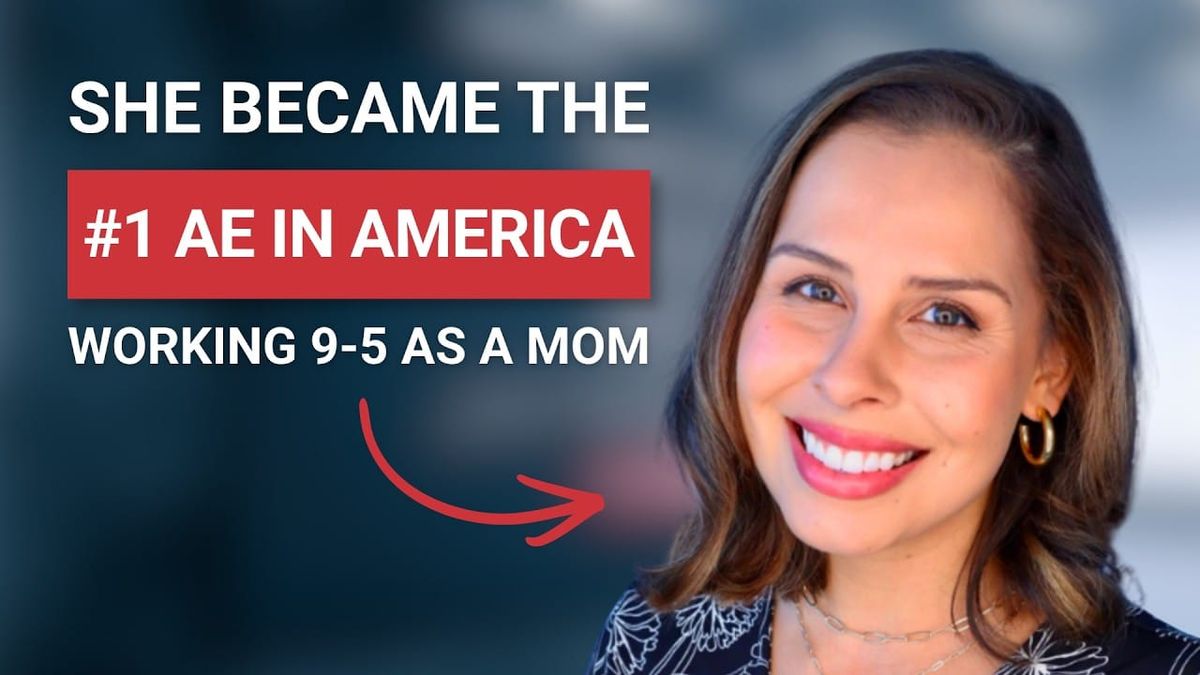
Working 9-to-5 as a Mother, One AE Hit 175% of Quota to Top All U.S. Sales Reps
Kelsey Knibble reached 175% of her sales quota and ranked as the top account executive in the United States while working standard business hours as a mother — a result she attributes to two fundamental changes in how she approached her work. She abandoned a transactional mindset focused on pushing prospects through a sales funnel and replaced it with a service orientation detached from whether any individual conversation produced a deal. Alongside that shift, she restructured her workday to concentrate almost exclusively on revenue-generating activities, eliminating low-value internal meetings and administrative tasks that consume most of a typical salesperson's day.
Her case is notable because it directly challenges two persistent assumptions in sales culture: that elite performance requires long hours, and that a results-obsessed mindset drives better outcomes than a process-focused one. Whether or not her specific path is replicable, the data point — a 9-to-5 working parent outperforming a national field of salespeople — offers a concrete argument that time allocation and mental approach matter more than raw hours logged.
"You were there to serve, not sell. And if we made a sale, great. And if we didn't, great."
Mindset Work Unlocked Sales Results That Eight Months of Strategy Coaching Could Not
For the first several months of working with a sales coach, Kelsey Knibble resisted any focus on mindset, insisting the problem was strategic rather than psychological. She wanted territory planning, messaging frameworks, and pipeline tactics — and she got them, without her results meaningfully shifting. The breakthrough came roughly eight months into the engagement, at a group mastermind event where a speaker laid out the argument that self-identity drives behaviour more reliably than any external playbook. Knibble describes committing on the drive home to eliminating every self-critical or self-limiting thought about her identity as a seller and a mother, and subsequently watching anxiety that had persisted through months of strategic coaching rapidly dissolve.
The sequence — skills first, mindset second, results third — inverts the order most professional development programmes follow, but the timeline makes the causal case awkward to dismiss. Results arrived after the identity work, not after the strategy work, despite both happening under the same coaching relationship. For organisations investing in sales training, the episode raises a question about sequencing: whether teaching technique before addressing the beliefs that govern its execution is simply the wrong order.
"If you first don't change your identity to be a top-notch elite seller, you're never going to start to act like one."
Sales Coaching Investment Doubled One Rep's Income From $200K to Over $400K in Two Years
Kelsey Knibble earned roughly $200,000 annually during her first two years in enterprise software sales. After joining a structured sales coaching programme at a cost of approximately $20,000, her income more than doubled — exceeding $400,000 in subsequent years, with additional recognition awards pushing total compensation above $500,000 in at least one year. Her coach frames the return as a 10x investment: $20,000 spent to generate an additional $200,000 in annual income, a ratio he argues would be unambiguously obvious if applied to a financial asset rather than a professional development programme.
The ROI framing, while presented by a party with a direct commercial interest in selling coaching services, highlights a real asymmetry in how professionals evaluate spending on their own capabilities versus spending on conventional assets. The broader claim — that income doublings consistently require external mentorship rather than self-directed effort — is harder to verify, but the pattern of plateauing earnings followed by rapid growth after structured coaching recurs frequently enough in high-commission fields to be taken seriously.
"If you go from $200K to $400K and you pay $20K, that's a 10x ROI. If I put $20,000 in the stock market and knew I'd get back $200,000, there wouldn't be a person on the planet who wouldn't take that bet."
Separating Personal Worth From Sales Results Is the Core Fix for Impostor Syndrome, Rep Says
Kelsey Knibble's impostor syndrome persisted not because she lacked competence but because she had tied her sense of personal worth entirely to her sales numbers — a coupling that made every missed deal a judgment on her adequacy as a person. The shift that quieted the self-doubt was conceptual rather than tactical: she stopped treating quota attainment as a measure of whether she deserved to be in the role and instead anchored her self-assessment to effort and intent. Replacing a persistent internal critical voice with a simpler orientation — showing up to understand and help — reduced the cognitive load of customer conversations significantly.
The pattern she describes is well-documented in performance psychology: anxiety generated by outcome-dependence consumes cognitive resources that would otherwise be available for the actual task. What is less commonly discussed in sales contexts is the practical intervention — not positive thinking as an abstraction, but specifically severing the link between professional results and personal identity. For the large share of salespeople who experience quota pressure as an existential threat rather than a business metric, that reframe may matter more than any tactical upgrade.
"Your worthiness as a human, as an individual, is not tied to your quota or your attainment. It just is not."
Elite Sales Rep Blocks Four Hours Daily for Revenue Activities, Adds 'White Space' for Strategic Thinking
After two years of using the structured planning system described in Brian Moran's book The 12-Week Year, Kelsey Knibble says the habits became sufficiently ingrained that she transitioned to a self-designed hybrid approach. The core remains calendar blocking: she reserves two hours each day for advancing existing pipeline and another two hours for prospecting and creating new pipeline, for a total of ten hours per week dedicated to revenue-generating work. Each category is colour-coded on her calendar, making non-compliance visually obvious. More recently she has added deliberate unscheduled time — white space she uses for walks, reflection, or simply sitting outside — which she says surfaces creative thinking that structured work blocks do not.
The evolution from an external system to an internalised one follows a pattern familiar in habit formation research: external scaffolding is most valuable early, when behaviours are not yet automatic, and can be shed once the underlying priorities are deeply embedded. For salespeople struggling to maintain consistent prospecting alongside a full portfolio of active deals, Knibble's architecture offers a concrete starting point — and a reminder that even with significant deal flow, she prospects every single day.
"I create space for ideation — I actually prefer to see white space on my calendar now. It makes me feel like I have breathing room, and that's when a lot of the problems you fester on during the day kind of dissipate."
Also mentioned in this video
- Ian presenta a Kelsey Knibble, quien ha estado en el programa "Untap Your Sales… (1:51)
- Kelsey Knibble agradece a Ian por invitarla al podcast y comparte su… (3:32)
- Su pasado como una persona ansiosa y llena de dudas, sintiéndose un "muñeco de… (6:45)
- Kelsey explica que observó el estrés y la dedicación al trabajo de sus padres y… (9:01)
- Ian pregunta a Kelsey sobre el punto de inflexión que la llevó a invertir… (11:00)
- Ian enfatiza que para cambiar la mentalidad y lograr el éxito, es crucial creer… (29:33)
- Kelsey explica que utilizó la meditación y el diario para identificar y… (33:00)
- Kelsey explica que, aunque se siente cansada al final del día como madre de una… (43:40)
- Kelsey comparte que, además del trabajo y la familia, ha aprendido a priorizar… (47:08)
- Ian y Kelsey discuten la importancia del "espacio en blanco" en la agenda para… (53:32)
- Su vida actual como de paz y seguridad, a pesar de la turbulencia del mercado,… (1:09:41)
Summarised from Ian Koniak Sales Coaching · 1:16:45. All credit belongs to the original creators. Streamed.News summarises publicly available video content.