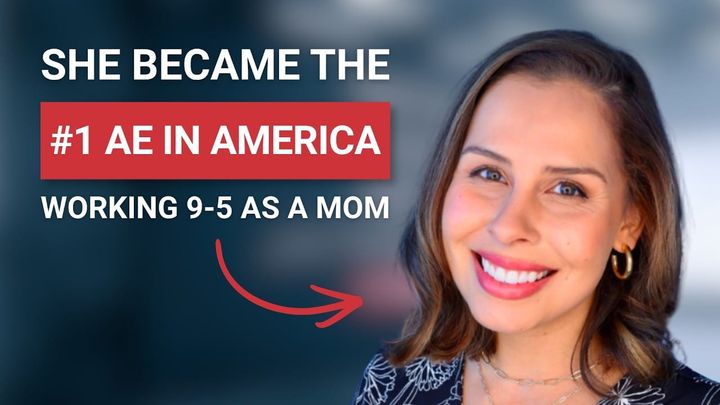
Original source: Ian Koniak Sales Coaching
This video from Ian Koniak Sales Coaching covered a lot of ground. 7 segments stood out as worth your time. Everything below links directly to the timestamp in the original video.
If you sell anything with a long sales cycle, the fastest path to revenue may be figuring out which doors to stop knocking on first.
Enterprise Sales Rep Reveals How Knowing Who Won't Buy Is as Valuable as Finding Who Will
Christina Godwin, an enterprise account executive at Workday, argues that the first move in a new territory is not to chase the most promising accounts but to quickly disqualify the dead ends. She travels in person to accounts she suspects won't buy specifically to confirm it, freeing her to concentrate on those leaning in. That discipline paid off dramatically: in the year she applied this framework, a single engaged account delivered 80 percent of her annual quota. She also tracks macroeconomic tailwinds — citing HVAC, construction, and field services as private-equity-backed sectors currently growing fast — as a shortcut to identify where deals are most likely to close.
The approach reframes how salespeople should think about time. Rather than spreading effort across a territory hoping something sticks, Godwin treats early disqualification as an investment. The principle applies well beyond enterprise software: in any high-stakes, long-cycle negotiation, quickly mapping out who is not a realistic buyer is what allows a professional to go deep where it actually matters.
"Knowing that they're not going to buy is just as important as ones that are going to buy, so that you do know where to focus your time."
Workday Sales Rep Brings Entire Cross-Functional Team to Executive Meetings — and Keeps the CTO on Standby
Preparing for a high-stakes executive meeting in Charlotte, Godwin assembled a full internal team ready to discuss artificial intelligence, product optimization, and new implementations — all simultaneously. She had Workday's CTO available on Slack to dial in if needed. The goal was not to deliver a rehearsed pitch but to arrive with a credible hypothesis about where the customer needed help, then invite the executive to redirect. That combination of structured preparation and visible commitment, she argues, builds the trust that makes executives willing to reveal their real priorities.
The tactic reflects a broader shift in enterprise selling: with senior buyers spending less time with vendors, arriving with a preformed point of view — rather than an open-ended questionnaire — has become a way to signal competence and earn deeper access. The same logic applies to any advisory relationship where credibility must be established quickly.
"When you bring a point of view or a hypothesis of where and how you can help, it almost never misses the mark. What it does is it builds trust and credibility for them to open up."
Namedropping a Local Competitor's CFO Transformed a Clinical Research Meeting — A Case for Hyper-Local References
Walking into a meeting with a clinical research organization, Godwin mentioned by name a nearby company's CFO who had implemented the same Workday product — someone she had learned about through colleagues managing similar accounts, not her own client. The room shifted immediately: by the meeting's end, the prospect was asking to be connected with that CFO directly. The reference worked in part because it was local and the name was already familiar, making the social proof feel immediate and concrete rather than abstract.
The episode illustrates a principle that applies broadly to any complex sale or advisory pitch: a third-party reference from the same geography or subindustry carries disproportionate weight because it eliminates the psychological distance between 'someone else's problem' and 'our situation.' Finding that reference requires extra legwork — in this case, calling colleagues and requesting internal customer lists — but the return, Godwin suggests, is a trust shortcut that no product feature can replicate.
"If I can get their time, I can sell them Workday — but getting their time is really hard. And getting their time again is really hard. So you've got to make their time really valuable."
Enterprise Seller's Qualifying Checklist: Technology Decisions, Implementation Bandwidth, and Early List Pricing
Godwin qualifies accounts against three concrete checkpoints before investing serious time. First, she asks directly at the start of a relationship whether the company is planning any technology decisions that year and requests to be included. Second, she checks whether the organization is already mid-implementation on another platform — citing examples like a Salesforce upgrade or a major staffing system rollout — since a company stretched across simultaneous projects is unlikely to take on another. Third, she shares an approximate list price early, telling buyers they can negotiate when they are ready to commit, but making clear she needs firm executive alignment before she can move forward. She is also deliberate about customer references, asking upfront whether one would help rather than waiting until late in the cycle, when scheduling alone can add weeks to a deal.
The framework matters because it addresses a common failure mode in enterprise sales: reps invest months in a deal that was never fully funded or sanctioned. Each of these checks is designed to surface a structural obstacle before it becomes a late-stage surprise — a discipline that maps directly onto any high-value negotiation, from procurement to partnership discussions.
"I will give them list price plus some and say, when you decide, we can work on pricing — but I need to know timing, and I'll need some exact alignment."
How Quickly a Prospect Can Get an Executive on the Phone Predicts Whether the Deal Will Close
Godwin defines a sales champion with unusual precision: not someone who can sell the product internally, but someone who can get the account executive in front of the economic buyer. How fast they can arrange that meeting, she says, is itself a diagnostic signal. In one recent deal, a VP of HR set up a procurement sync with a senior executive for eight the following morning — outside normal working hours — demonstrating both her organizational influence and the deal's real momentum. Conversely, a champion who hedges or delays on that request is signaling that the deal may be weaker than it appears. Direct executive access also provides a practical forecast benefit: executives know their own approval chains, board meeting schedules, and CEO travel calendars in ways that mid-level contacts simply do not.
The observation cuts to a structural problem in enterprise sales, where deals frequently slip not because of product fit but because the seller is working with someone who lacks the authority or visibility to navigate the internal approval process. Godwin's framing — that losing deals almost always comes down to not engaging with the right decision-maker — is consistent with what most enterprise sales methodologies teach, but her specific test for identifying a genuine champion is more operational than most.
"My definition of a champion is someone who can get you in front of the economic buyer and the decision maker. That's it. They don't need to be able to sell it themselves."
When a CIO Derailed an Executive Meeting, a Pivot to AI Got the Conversation Back on Track
During a major meeting she had staffed with roughly ten people, Godwin found the client's CIO going off at length about a frustration with promoting employees inside Workday — a problem far removed from the strategic agenda. Rather than letting the session stall, she acknowledged the concern briefly, offered to follow up by email, and pivoted by asking the CIO about his philosophy on artificial intelligence in the organization. The move changed the subject to something he clearly wanted to discuss while also generating useful intelligence about his decision-making style. She draws a related lesson from an accounting firm dinner, where a COO spent ten and a half months deciding on a kitchen paint color — a detail she read as a reliable predictor that the resulting deal would move slowly, which it did.
Both examples point to the same underlying skill: treating every conversation, even a derailing one, as data about how the buyer thinks and makes decisions. That kind of real-time behavioral reading is difficult to train formally, but Godwin's specific techniques — redirecting with a question about a topic the buyer is likely to engage on, using team messaging to coordinate quietly mid-meeting — are concrete enough to be adopted immediately.
"It doesn't really matter what you're talking about — think about what they're saying and how you can apply it to their decision-making process."
Beyond AI Prompts: Enterprise Sellers Are Tapping Ex-Employees and Consulting Contacts for Pre-Sale Intelligence
Godwin uses Gemini, ChatGPT, and intent data as baseline research tools, but describes them as table stakes. Her differentiated intelligence comes from people: she contacts colleagues at Big Four consulting firms — naming Deloitte as an example — to obtain internal client assessments that map out a company's challenges and strategic priorities. She also reaches out directly on LinkedIn to sales reps at non-competing vendors who serve the same account, asking what they have observed. Former employees are another source. For internal reconnaissance, she recommends talking to back-office staff, noting that people outside the revenue organization are rarely courted by vendors and respond well to small gestures — branded merchandise, drinks — that front-line salespeople would typically direct only at senior buyers.
The approach highlights a gap between how AI research tools are marketed and how they actually function in competitive enterprise deals. Structured data about a company's technology spending or stated priorities is increasingly available to everyone; the edge comes from qualitative, relationship-sourced knowledge about how a specific organization actually buys, who the real blockers are, and what went wrong in previous implementations.
"I go the extra mile because I want to talk to people that have actually worked with the organization."
Also mentioned in this video
- Christina explica que el programa le enseñó a priorizar actividades generadoras… (0:00)
- Christina comparte su trayectoria, desde su origen humilde en Savannah,… (3:47)
- Ian destaca cómo la formación en contabilidad y experiencia como consultora de… (9:04)
- Christina explica que su motivación proviene del dinero y su sólida ética de… (11:12)
- Christina explica que su experiencia como madre la obligó a ser más eficiente,… (12:49)
- Ian y Christina discuten la importancia de la rendición de cuentas, cómo ella… (15:19)
- Ian le pide a Christina que detalle su enfoque táctico, preguntándole sobre la… (17:33)
- Ian pregunta a Christina sobre su enfoque para interactuar con ejecutivos y… (23:38)
- Ian le pregunta a Christina si alguna vez sufre del síndrome del impostor, a lo… (31:08)
- Ian pregunta a Christina sobre su proceso para conseguir reuniones con… (32:07)
- Christina enfatiza la importancia de las reuniones presenciales para comprender… (34:39)
- Ian y Christina discuten cómo el mensaje para nuevos clientes difiere del de… (36:11)
- Christina explica que su capacidad para mantener un horario de 9 a 5 y su… (49:29)
- Jake Carlson pregunta a Christina cómo manejó la presión de la dirección para… (51:11)
- Joshua pregunta a Christina sobre su método poco convencional para conseguir… (1:02:06)
- Michelle, una nueva en ventas, busca consejo sobre cómo encontrar un equilibrio… (1:03:38)
Summarised from Ian Koniak Sales Coaching · 1:09:40. All credit belongs to the original creators. Streamed.News summarises publicly available video content.